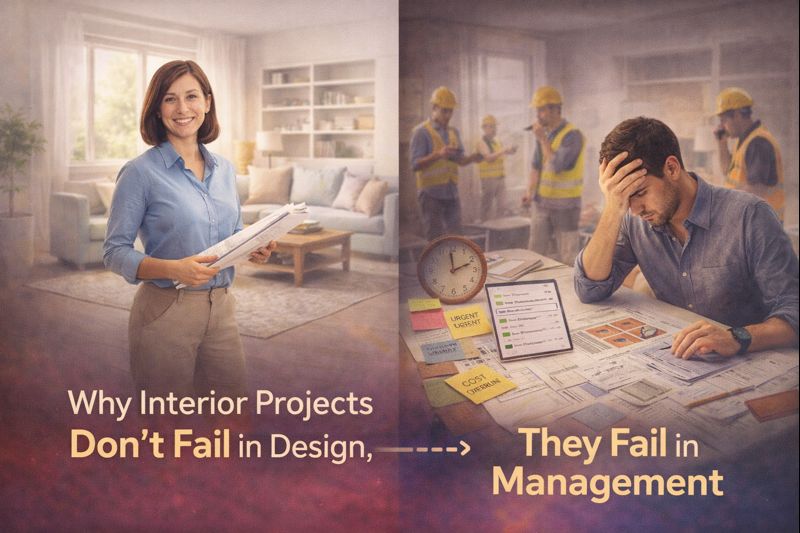
Introduction: Growth Is When Things Start to Break
Most interior studios don’t fail when they’re small.
They struggle when they grow.
New clients arrive.
Projects overlap.
Teams expand.
Delivery pressure increases.
And suddenly, the same studio that handled five projects effortlessly now feels constantly behind at twelve.
The instinctive response is to blame capacity or talent.
In reality, the first thing that fails is process—specifically, how decisions, approvals, and changes are managed across multiple projects.
Why Talent Doesn’t Scale on Its Own
Interior studios are often built around strong individuals:
- founders with vision
- senior designers with intuition
- project leads who “just know” what’s going on
This works—until it doesn’t.
As projects increase:
- no one has full visibility
- context lives in people’s heads
- decisions depend on availability
- memory becomes the bottleneck
The studio doesn’t lack skill.
It lacks shared project memory.
The Breaking Point: When Informal Communication Stops Working
Early on, studios rely on:
- conversations
- Slack messages
- emails
- verbal approvals
These methods feel efficient—but they don’t scale.
At scale:
- messages get missed
- approvals get assumed
- versions get confused
- responsibility blurs
What once felt flexible now feels chaotic.
Interior CRM becomes essential at this stage—not as bureaucracy, but as infrastructure.
Why Scaling Increases Risk, Not Just Volume
As studios scale, risk multiplies:
- more clients = more interpretations
- more designers = more handoffs
- more consultants = more dependencies
Without clear systems, small misunderstandings turn into big problems.
Interior CRM reduces this risk by:
- standardizing decision capture
- centralizing approvals
- making scope evolution visible
- preserving context across teams
Growth stops being fragile.
How Interior CRM Enables Delegation Without Losing Control
One of the hardest parts of scaling is letting go.
Founders hesitate to delegate because:
- they don’t trust visibility
- they fear misalignment
- they feel responsible for every decision
Interior CRM makes delegation safer by ensuring:
- decisions are recorded
- approvals are visible
- accountability is shared
Leaders no longer need to be everywhere to stay informed.
Junior Teams Perform Better With Clear Boundaries
Junior designers don’t struggle because they lack creativity.
They struggle because they lack context.
When approvals, scope, and expectations are unclear:
- juniors hesitate
- work gets redone
- confidence drops
Interior CRM gives junior teams:
- clarity on what’s approved
- confidence in what’s current
- protection from rework
This accelerates learning and improves output quality.
Scaling Without Burning Out Senior Designers
Senior designers often become the glue holding everything together.
They answer questions.
They resolve confusion.
They remember history.
At scale, this leads to burnout.
Interior CRM reduces dependency on individuals by embedding knowledge into the system. Senior designers spend less time explaining and more time designing and mentoring.
Why Clients Experience Scaled Studios as “More Professional”
Clients may not see internal processes—but they feel the results.
Studios with Interior CRM:
- respond faster
- explain changes clearly
- manage expectations confidently
- avoid repeated mistakes
This professionalism builds trust and supports premium positioning.
Scaling Beyond Interior Delivery Into AEC Execution
As projects grow larger and more complex, interior scope increasingly intersects with:
- BIM coordination
- consultant workflows
- procurement
- site execution
Interior CRM stabilizes intent before this transition.
When projects move into deeper AEC execution, platforms like Ruwaq Design extend that stability into coordination, validation, and delivery—ensuring scaled interior teams don’t lose control when technical complexity increases.
Why interiorcrm.com Becomes the Authority for Growth-Stage Studios
The role of interiorcrm.com is to speak directly to studios at the growth threshold.
Not beginners.
Not enterprise giants.
But teams that are good—and want to scale without breaking.
By focusing on:
- delegation
- visibility
- decision clarity
- risk reduction
the domain earns trust where it matters most: at the moment studios decide whether to systemize or stall.
Conclusion: Scaling Is a Process Problem, Not a People Problem
Interior studios don’t hit ceilings because they lack talent.
They hit ceilings because informal systems collapse under scale.
Interior CRM doesn’t remove creativity.
It removes chaos.
Studios that scale successfully don’t work harder.
They remember better, communicate clearly, and protect intent across growth.
That’s how interior teams grow without losing what made them good.